




Videos to understand fluid flows and solve problems like a professional.
I am Olivier Cleynen and I like to explain fluid mechanics as if you were my new work colleague.
Here you can learn how to think like a fluid dynamicist — how to frame problems, compute the key quantities, and decide what is important in your fluid flow.
I have a PhD in fluid mechanics but this course is not academic. I cut the usual fluff (edge cases, made-up laminar flows, long proofs) to get to the important stuff:
How to deal with turbulence
Which equations will tell you what
How CFD software works (and why it’s so slow!)
How to find out what controls a specific flow.
To be comfortable in this course, you will need solid high-school-level math & physics (vectors, calculus, solid mechanics). From there, we will progress rapidly, in chunks of ten minutes each.
I release videos as time permits and will experiment with channels and pricing. Register here to be notified of updates.
Here is a preview of the course: ↓
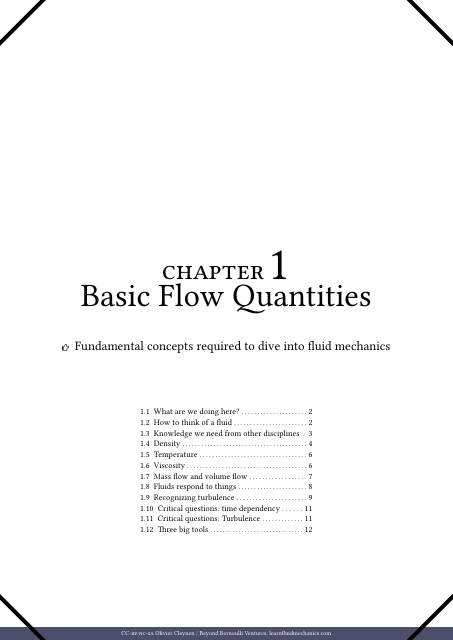
1 Basic flow quantities
Fundamental concepts required to dive into fluid mechanics
1.1 How to think of a fluid
1.2 Density
1.3 Viscosity
1.4 Mass flow and volume flow
1.5 Fluids respond to things
1.6 A first look at turbulence
1.7 Critical questions: time dependency
1.8 Critical questions: Reynolds number
1.9 Turbulence and stability
2 Analysis of existing flows
Quantify the forces, moments, and powers associated with an existing flow
2.1 Mass balance
2.2 Visualizing mass balance
2.3 Mass balance: an example
2.4 Mass balance: annother example
2.5 Momentum balance
2.6 Momentum balance: an example
2.7 Energy balance
2.8 Energy balance: example
2.10 Kill the Bernoulli equation
2.11 Non-uniform and unsteady flows
2.12 Limits of this method
3 Working with pressure and shear
Quantify the effect of pressure and shear in fluids
3.1 Pressure on hard surfaces
3.2 Pressure on hard surfaces: example
3.3 Pressure within fluids
3.4 Special case: buoyancy
3.5 Shear on hard surfaces
3.6 Shear on hard surfaces: example
3.7 Shear within fluids
3.8 Shear perpendicular to a surface
3.9 Shear and velocity
4 Prediction of fluid flows: theory and practice
Understand how fluid flow is calculated using computers (Computational Fluid Dynamics)
4.1 Fields, not trajectories
4.2 Time changes on a grid: example
4.3 Time changes on a grid
4.4 Mass balance equation: general case
4.5 Mass balance equation: incompressible flow
4.6 Momentum balance: general case
4.7 Momentum balance: incompressible flow
4.8 Energy balance
4.9 CFD: discretizing the momentum equation
4.10 CFD: the most basic loop
4.11 CFD: modeling turbulence
4.12 CFD: recap
5 Deciding what matters
Identify which parameters influence your flow, and which don’t